We Go Fast,You Go Forward
July 26, 2026
Golden Gate Cloning has become one of the most powerful molecular biology techniques for synthetic biology, plasmid construction, metabolic engineering, and CRISPR applications. By leveraging the unique properties of Type IIS restriction enzymes, researchers can assemble multiple DNA fragments in a single reaction with remarkable efficiency and accuracy.
Golden Gate Cloning is a molecular cloning method that enables the seamless assembly of multiple DNA fragments in a predefined order using Type IIS restriction enzymes and DNA ligase in a one-pot reaction.
Unlike traditional restriction enzymes that cut within their recognition sequence, Type IIS enzymes cut outside of their recognition sites, generating customizable overhangs that allow DNA fragments to be assembled without leaving unwanted scar sequences.
This approach was first described by Engler et al. in 2008 and has since become a cornerstone technology in:
Synthetic biology
Gene synthesis workflows
Pathway engineering
CRISPR construct generation
Protein engineering
High-throughput plasmid construction
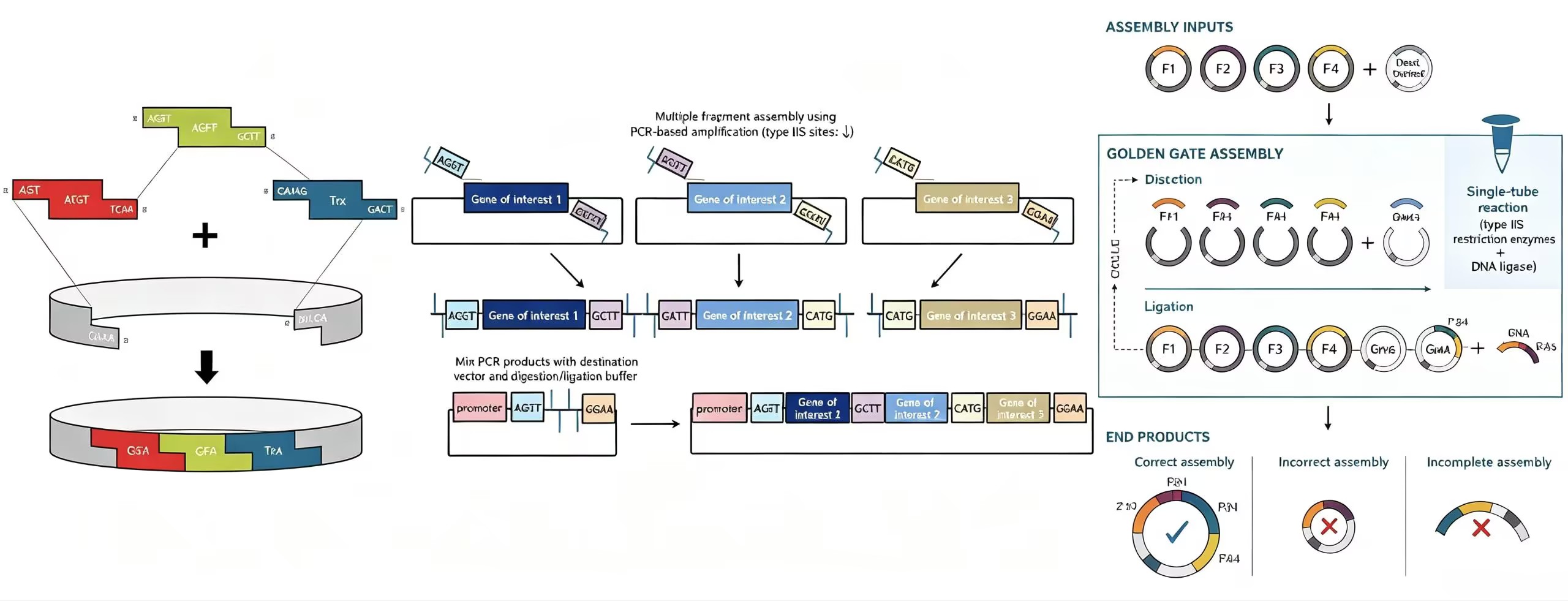
Golden Gate Cloning relies on two enzymes working simultaneously:
Type IIS Restriction Enzyme
Examples: BsaI, BsmBI, BbsI
Recognizes a specific sequence
Cuts outside its recognition site
DNA Ligase
Joins DNA fragments with matching overhangs
Step 1: Design DNA Fragments
Each DNA fragment is flanked by Type IIS recognition sites.
Example:
BsaI - Fragment A - BsaI
BsaI - Fragment B - BsaI
BsaI - Fragment C - BsaI
Step 2: Generate Unique Overhangs
After digestion, the enzyme creates custom 4-bp overhangs.
Example:
Fragment | Left Overhang | Right Overhang |
A | AATG | GCTT |
B | GCTT | CGGA |
C | CGGA | TACT |
These complementary overhangs dictate the assembly order.
Step 3: One-Pot Digestion and Ligation
All fragments, destination vector, restriction enzyme, and ligase are mixed together.
During thermal cycling:
Restriction enzyme cuts DNA
Complementary overhangs anneal
Ligase seals the junctions
Incorrect assemblies are repeatedly recut, while correctly assembled products become resistant to further digestion.
Step 4: Transformation and Screening
The final construct is transformed into competent cells for propagation and verification.
Traditional cloning often requires multiple rounds of digestion, purification, and ligation.
Golden Gate Cloning performs all steps in a single tube.
Feature | Traditional Restriction Cloning | Gibson Assembly | Golden Gate Cloning |
One-Pot Assembly | No | Yes | Yes |
Multi-Fragment Assembly | Limited | Good | Excellent |
Scarless Junctions | No | Yes | Yes |
Assembly Efficiency | Moderate | High | Very High |
Automation Friendly | Moderate | High | Excellent |
Cost for Large Constructs | High | Moderate | Low |
Suitable for Combinatorial Libraries | Poor | Moderate | Excellent |
Recognition sites are removed during assembly, resulting in scarless constructs.
This is especially important for:
Protein fusion constructs
Regulatory element engineering
Metabolic pathway design
2. High Efficiency
Researchers routinely achieve:
90% correct assemblies
Simultaneous assembly of 10–20 fragments
Minimal screening effort
3. Rapid Workflow
The entire assembly reaction can often be completed within:
Step | Time |
Reaction Setup | 15–30 min |
Digestion/Ligation Cycling | 1–2 h |
Transformation | 30 min |
Colony Screening | Overnight |
Golden Gate Cloning is widely used in:
Synthetic biology foundries
Automated DNA assembly pipelines
CRISPR library generation
Gene circuit construction
Enzyme | Recognition Sequence | Cleavage Position | Typical Applications |
BsaI | GGTCTC | 1/5 | Standard Golden Gate |
BsmBI | CGTCTC | 1/5 | Modular cloning systems |
BbsI | GAAGAC | 2/6 | CRISPR cloning |
SapI | GCTCTTC | 1/4 | Specialized assemblies |
Several standardized systems have been built around Golden Gate technology.
MoClo (Modular Cloning)
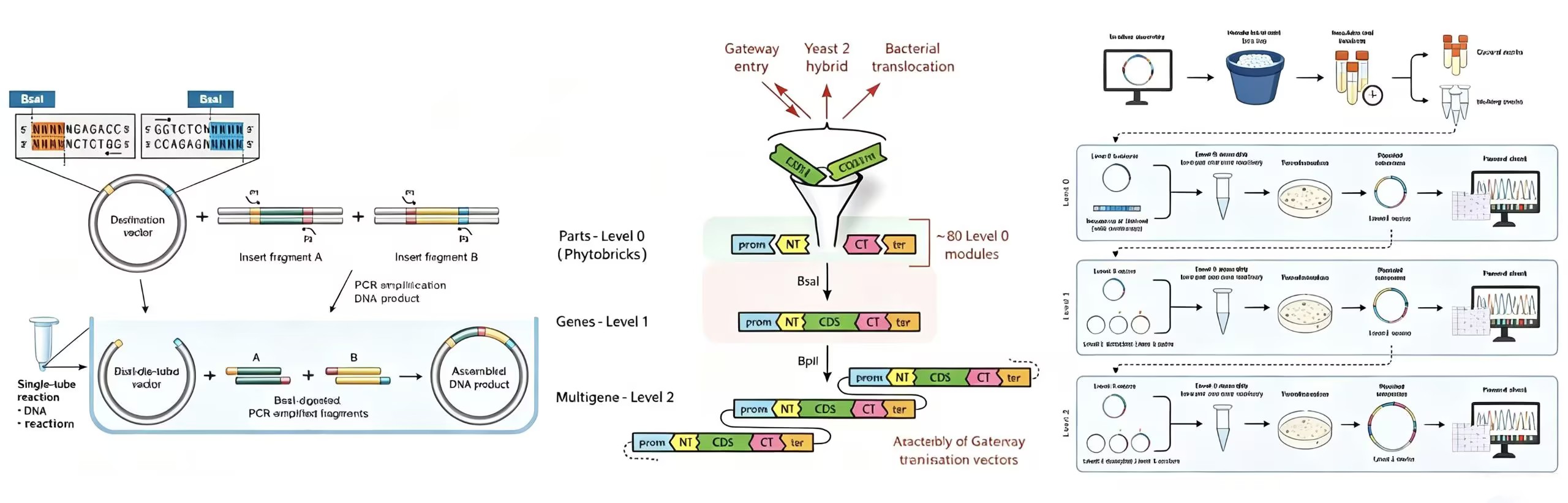
MoClo enables hierarchical assembly of:
Promoters
Coding sequences
Terminators
Regulatory elements
into increasingly complex genetic constructs.
GoldenBraid
Widely adopted in plant synthetic biology for iterative DNA assembly.
Advantages include:
Reusability of modules
Standardized overhang design
Flexible construct expansion
Loop Assembly
Designed for recursive assembly of large DNA constructs with minimal complexity.
Construction of:
Genetic circuits
Biosensors
Metabolic pathways
Golden Gate Cloning is commonly used to build:
sgRNA expression vectors
Multiplex CRISPR systems
CRISPR-Cas9 plasmids
Applications include:
Domain swapping
Fusion proteins
Enzyme optimization
Researchers can rapidly assemble entire biosynthetic pathways containing multiple genes.
Examples include:
Biofuel production
Pharmaceutical biosynthesis
Industrial enzyme development
Despite its advantages, several challenges should be considered.
Challenge | Description |
Internal Type IIS Sites | DNA fragments must not contain the same enzyme recognition sites used for assembly |
Overhang Design | Poorly designed overhangs can reduce assembly efficiency |
Large Constructs | Very large assemblies may require hierarchical strategies |
Sequence Verification | Final constructs should always be confirmed by sequencing |
To overcome internal restriction sites, researchers often perform domestication, introducing silent mutations that preserve protein sequence while removing problematic enzyme sites.
Both techniques are powerful DNA assembly methods, but they excel in different scenarios.
Parameter | Golden Gate | Gibson Assembly |
Assembly Principle | Type IIS digestion + ligation | Exonuclease overlap assembly |
Scarless | Yes | Yes |
Number of Fragments | Excellent for many fragments | Moderate |
Standardization | Excellent | Limited |
Library Construction | Outstanding | Good |
Automation | Excellent | Good |
Design Complexity | Moderate | Moderate |
Choose Golden Gate When:
Building multiple DNA fragments
Creating CRISPR libraries
Constructing modular plasmids
Performing high-throughput cloning
Choose Gibson Assembly When:
Working with large DNA fragments
Assembling constructs with flexible junctions
Rapidly joining a few fragments
Use non-palindromic overhangs with high ligation fidelity.
Remove Internal Restriction Sites
Domesticate sequences before assembly.
Optimize Fragment Ratios
Typical molar ratio:
Insert : Vector = 2–5 : 1
Verify Final Constructs
Always confirm assembly by:
Colony PCR
Restriction analysis
Sanger sequencing
Long-read sequencing for large plasmids
Golden Gate Cloning has revolutionized DNA assembly by enabling rapid, scarless, and highly efficient construction of complex genetic constructs in a single reaction. Its ability to assemble multiple fragments simultaneously makes it particularly valuable for synthetic biology, CRISPR engineering, metabolic pathway construction, and high-throughput cloning workflows.
As biological engineering projects continue to increase in complexity, Golden Gate Cloning remains one of the most versatile and scalable tools available to modern molecular biologists. Combined with accurate sequence verification technologies such as Sanger sequencing and long-read sequencing, it provides researchers with a robust workflow for designing, building, and validating genetic constructs with confidence.
Key Takeaways
Feature | Golden Gate Cloning |
Assembly Method | Type IIS Restriction Enzyme + Ligase |
Scarless Assembly | Yes |
Multi-Fragment Assembly | Excellent |
Typical Enzymes | BsaI, BsmBI, BbsI |
Common Applications | Synthetic Biology, CRISPR, Protein Engineering |
Throughput | High |
Automation Compatibility | Excellent |
Verification Recommended | Sanger or Long-Read Sequencing |

We Go Fast, You Go Forward
 sales.us@quintarabio.com
 1-617-789-6111
 3563 Investment Blvd, #2, Hayward, CA 94545sales.us@quintarabio.com1-617-789-611165 Grove St, Suite 102, Watertown, MA 02472sales.us@quintarabio.com1-617-789-611110410 Corporate Dr. Suite 118, Sugar Land, TX 77478
sales.us@quintarabio.com
1-424-549-091110601 Virginia Avenue, Culver City, CA 90232sales.us@quintarabio.com1-619-823-08956364 Ferris Square, Suite 102, San Diego, CA 92121Quintara Biosciences © 2025 All Rights Reserved | Site Map | Terms of Use | Privacy Policy


 Login
Login  Order
Order Contact Us
 Contact Us