Amplicon Sequencing is a targeted sequencing method that amplifies specific genomic regions of interest (amplicons) via PCR, then sequences these amplified products. Compared to whole-genome sequencing, this method concentrates sequencing depth on key target regions, significantly reducing costs and increasing the sensitivity of variant detection. As a full-service CRO provider, we help you quickly select the optimal sequencing service based on your amplicon size, amplicon complexity, research objectives, turnaround time, budget and throughput.

Feature | Sanger | Short-Read NGS (Illumina) | Long-Read NGS (Nanopore) |
Native Read Length | ~800–1,000 bp; primer walking required for longer fragments | 150–300 bp | Full amplicon length (up to 10 kb+), no fragmentation |
Single-Molecule Resolution | No, bulk averaged signal only | Yes, but short fragments break long-range linkage | Yes, full-length single-molecule intact reads |
Low-Frequency Variant Detection | Poor (only dominant alleles visible, ≥10% VAF) | Excellent (detects ~0.1–1% VAF) | Good (detects ~1–5% VAF) |
Haplotype Phasing Capacity | None | None (short reads cannot link distant variants) | Superior (links all mutations across full PCR fragment) |
Repetitive / High-GC Region Performance | Poor, ambiguous mixed peaks | Moderate, poor unique mapping for long repeats | Robust, continuous gapless coverage |
Multiplex Sample Capacity | Very low (1–2 fragments per sample) | High (hundreds of barcoded samples per batch) | High (96+ barcoded samples per single flow cell) |
Library Prep Complexity | Minimal, direct sequencing of purified PCR products | Complex: index PCR, dual indexing, fixed batch workflows | Simple barcode ligation |
Turnaround Time | Fast standard (24–48h) | Slow fixed batches (3–7 days) | Fast standard (24–48h) |
Raw Single-Read Accuracy | Highest | Very high | Moderate (consensus depth delivers high final accuracy) |
Best Use Cases | Short pure clonal fragment spot checks | High-throughput short amplicon cancer panels, quantitative low-VAF screening | Long PCR fragments, CRISPR mosaic editing, full-length microbial barcodes, viral/gene therapy QC |
Suitable for rapid verification of small, short-fragment, pure clone samples. It is the industry 'gold standard' for sequence verification and genotype confirmation due to its high accuracy and low cost.
Turnaround Time 1–2 Days
Starts at $4.99 / Sample
AmpExpress
For short amplicon analysis of large batches of samples, it enables ultra-high depth coverage and accurate quantification of low-frequency variants. It is the preferred solution for cancer screening and pathogen metagenomic research.
Turnaround Time 3-5 Days
Starts at $60 / Sample
AmpValue · AmpStandard · AmpPro
Enables full-length analysis of long-fragment amplicons, easily addressing complex genomic structures and haplotype phasing challenges.
Turnaround Time Overnight
Starts at $4.99 / Sample
Which sequencing method is suitable for your samples?
What is your amplicon length?
• <1kb: Proceed to the next step
• ≥1kb: Nanopore is the best full-length option
Pure clonal samples or mixed populations?
• Pure clone: Choose by throughput scale
• Mixed population: Need short-read NGS or Nanopore for deep analysis
What is your sample count per order?
• Small (<96): Sanger for quick validation
• Large (>96): Nanopore or NGS for high efficiency
Need low-frequency variant detection (<10% VAF) or quantification?
Yes: NGS or Nanopore (meet high sensitivity/quantification needs)
•No: Conventional Sanger or Nanopore suffices for low-cost validation of known sites
Need to clarify haplotype or allele linkage?
• Yes: Nanopore long reads are the only option (span long fragments directly)
• No: NGS short-read panels are more cost-effective for short amplicons
Research Objective
Confirm that a cloned construct contains the correct insert sequence without unintended mutations before downstream experiments such as protein expression, viral vector production, or genome engineering.
Recommended Service
Choose Sanger Sequencing for short, clean, single-template amplicons and routine local verification. It is the preferred method when the goal is to confirm a simple point mutation, junction, or insert region within a practical read length, providing fast and reliable validation of cloned constructs.
Choose Nanopore Sequencing when full-length amplicon analysis is required. Long-read sequencing enables comprehensive characterization of the entire PCR product in a single read, making it suitable for complex amplicons, primer-independent verification, and high-throughput screening workflows.
Research Objective
To determine the complete outcomes of genome editing by identifying and quantifying different allele variants, including knock-in, knock-out, and complex editing patterns across the target region.
Recommended Service
Choose Nanopore Sequencing when full-length allele resolution is required. Long-read sequencing enables direct characterization of complete amplicon structures, allowing accurate identification of knock-in/knock-out outcomes, complex indel patterns, and mixed editing populations.
Example application: In CRISPR-edited mosaic cell populations
Nanopore single-molecule sequencing directly reads individual DNA molecules to distinguish diverse editing products, estimates product frequency based on read counts, and provides full-length coverage to span large fragment variations, enable haplotype linkage analysis, and reveal the linkage state of mutations.
Choose NGS when precise quantification of editing outcomes is the primary goal. High-depth sequencing enables accurate measurement of edit frequencies, variant abundance, and SNP/indel distributions, making it suitable for short targeted loci and large-scale screening workflows.
Research Objective
To profile microbial diversity, detect targeted genetic variations, and characterize specific genotypes from complex environmental or biological samples.
Recommended Service
Choose NGS Sequencing when high-depth profiling and quantitative analysis are required. Targeted sequencing enables accurate characterization of microbial communities, targeted pathogens, immune repertoires, and barcode distributions.
Example applications:
- 16S / ITS Microbiome: Taxonomic profiling, community composition, relative abundance, and group-to-group comparison using targeted amplicons.
- Targeted Pathogen / Strain ID: Species detection, strain differentiation, and surveillance assays for defined microbial targets.
- TCR / BCR & Barcode Counting: Clonotype diversity, immune repertoire dynamics, engineered construct barcodes, and variant counting.

Submit your sequencing request online and confirm project requirements, turnaround time, and specific analysis needs with our expert team.

Benefit from free same-day pick-up across the US. We handle transport with the utmost care to ensure sample integrity and timely arrival.

High-quality library preparation is followed by next-generation sequencing (NGS) on cutting-edge platforms for accurate and reliable results.

Rigorous bioinformatics analysis and strict quality control ensure data validity. We deliver secure raw data files and a detailed final analysis report.


Accelerate research with Quintara’s accurate, reliable Sanger Sequencing overnight.
Discover more
Quintara delivers fast, affordable NGS sequencing using advanced platforms.
Discover more
Nanopore amplicon sequencing enables fast long‑read targeted validation.
Discover more
We Go Fast, You Go Forward
 sales.us@quintarabio.com
 1-617-789-6111
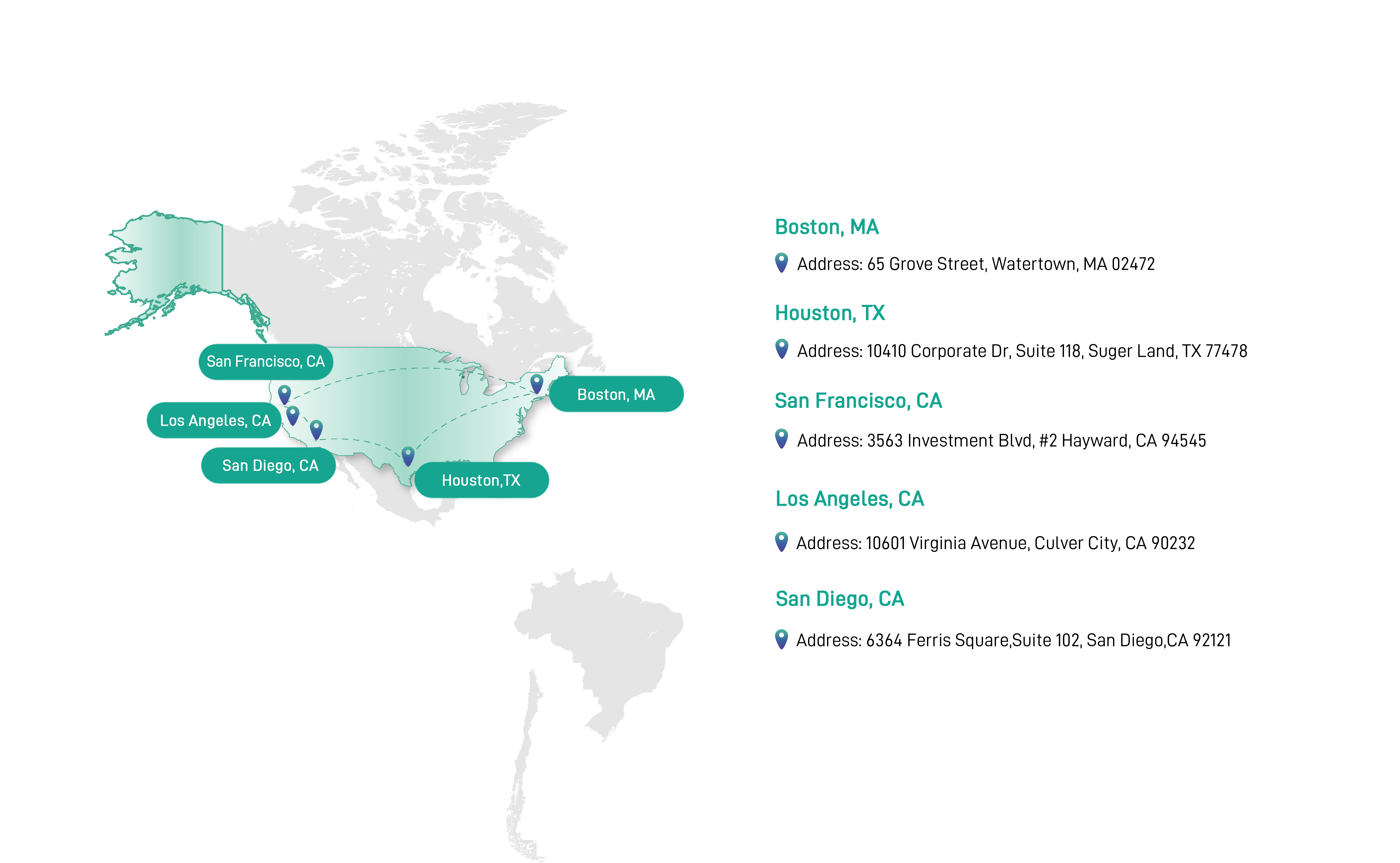
 3563 Investment Blvd, #2, Hayward, CA 94545sales.us@quintarabio.com1-617-789-611165 Grove St, Suite 102, Watertown, MA 02472sales.us@quintarabio.com1-617-789-611110410 Corporate Dr. Suite 118, Sugar Land, TX 77478
sales.us@quintarabio.com
1-424-549-091110601 Virginia Avenue, Culver City, CA 90232sales.us@quintarabio.com1-619-823-08956364 Ferris Square, Suite 102, San Diego, CA 92121Quintara Biosciences © 2025 All Rights Reserved | Site Map | Terms of Use | Privacy Policy


 Login
Login  Order
Order Contact Us
 Contact Us