We Go Fast,You Go Forward
June 01, 2026
The paradigm of genomics is shifting. For decades, researchers have relied on traditional short-read platforms to decode genetic information. However, as molecular biology, synthetic biology, and clinical research continue to advance, scientists increasingly encounter complex genomic structures that demand higher-resolution approaches.
For a long time, scientific research and clinical customers have been troubled by:
Short reads cannot assemble repetitive / high-GC regions
Sanger needs multiple primers and cannot detect structural variationslouisa
Traditional sequencing cannot take into account speed, length, and epigenetics
This is where third-generation long-read technology comes in.
As a comprehensive sequencing service provider with Sanger, NGS, and Nanopore platforms, we focus on third-generation long-read Nanopore sequencing to provide you with real-time, ultra-long, unbiased, full-structure sequencing solutions to solve the problems that traditional technologies cannot solve.
However, what exactly is nanopore sequencing used for, and how does it overcome the limitations of traditional platforms? In this comprehensive guide, we will explore the mechanics of this groundbreaking technology and detail its core applications—with a special focus on how Quintara Biosciences’ Whole Plasmid and Amplicon Sequencing services are accelerating modern research.

To understand its applications, we must first ask: what is nanopore sequencing and how does nanopore sequencing work?
Nanopore sequencing belongs to the third generation of sequencing technologies, widely known as long-read sequencing. Unlike traditional Next-Generation Sequencing (NGS) platforms like Illumina, which rely on synthesizing DNA and capturing optical fluorescence, Nanopore technology utilizes a completely different mechanism based on electrical signals.
During the process, a single strand of native DNA or RNA is pulled through a microscopic "nanopore protein channel" embedded in an electrically resistant membrane. As the nucleic acid passes through the pore, it disrupts the ionic current flowing across the membrane.
Electrical Signal vs. Fluorescence:By measuring electrical disruption rather than optical fluorescence, Nanopore eliminates the need for bulky cameras and delicate optical equipment.
Real-Time Sequencing: The sequence is generated and analyzed instantly, providing real-time data output.
Native DNA Sequencing: Nanopore can sequence native, unamplified DNA. This means there is no requirement for PCR amplification or chemical labeling, effectively eliminating amplification bias, therefore, truly restore the sample genome state.
Ultra-Long Reads: Because the read length is determined only by the length of the intact DNA fragment, it can generate ultra-long reads (ranging from tens of kilobases to megabases), a stark contrast to the 50–300 base-pair limits of short-read platforms.
The unrestricted read length and real-time capabilities of this platform have transformed genomics. Nanopore sequencing is used for resolving complex genomic regions that short-read sequencing cannot accurately assemble.
Today, Nanopore sequencing is widely used across multiple disciplines, including:
Genome Sequencing: De novo assembly of complex, polyploid, or highly repetitive genomes.
Gene Editing Validation: Accurately assessing CRISPR on-target and off-target effects.
Pathogen Detection: Rapid, real-time identification of microbes and antimicrobial resistance (AMR) genes.
Plasmid Verification: Confirming the complete structural integrity of synthesized plasmids and vectors.
Amplicon-Based Targeted Sequencing: Deep profiling of specific genetic regions, mutations, and transcripts.
Epigenetics Research: Direct detection of DNA methylation without harsh chemical treatments.
For researchers in synthetic biology, molecular cloning, and vector design, verifying the accuracy of a constructed plasmid is paramount. Traditional Sanger sequencing requires multiple primers, while short-read NGS fails to assemble highly repetitive sequences accurately.
Powered by our proprietary library preparation workflows and Oxford Nanopore technology, Quintara Biosciences’ Whole Plasmid Sequencing solves these issues entirely, offering fast, comprehensive sequencing for plasmids up to 25 kb.
Traditional methods often yield fragmented assemblies. Full plasmid sequencing avoids this by capturing the entire circular molecule de novo. This primer-free validation confirms the complete plasmid structure, allowing for the precise detection of sequence variants and structural indels.
When building complex vectors, you must ensure the insert is correct. Nanopore allows you to verify correct gene insertion, perform directional cloning confirmation, and conduct multi-fragment assembly QC.
Illumina struggles significantly with GC-rich plasmids and repetitive elements. With Quintara Biosciences' WPS Standard tier, long reads effortlessly resolve repeats, secondary structures, and high-GC regions (like CAG-rich promoters, LTRs, or ITRs in AAVs), ensuring accurate assessment of viral vector integrity.
Before moving to expensive downstream applications, sequence verification is crucial. Nanopore provides rapid Open Reading Frame (ORF)and frame-shift verification, alongside fusion tag and linker confirmation.
Quintara Biosciences’ Plasmid Service Tiers:
We offer highly cost-effective, flat-rate options with no hidden fees and overnight turnaround:
WPS Express ($4.99 / Overnight): Ideal for high-throughput construct screening of non-complex plasmids (<10kb).
WPS Standard ($15.00 / Overnight): The industry standard for routine plasmid verification, perfectly designed to handle complex sequences up to 25kb.
Both tiers accept a wide variety of inputs: Plasmid DNA, RCA Products, Colony Suspensions, Bacterial Overnight Cultures, and Glycerol Stocks. Deliverables include FASTA, GenBank, AB1 chromatograms, and access to our Interactive QC Tool.
When researchers need to perform deep, targeted analysis of specific genomic regions, Quintara Biosciences’ Amplicon Sequencing offers unparalleled resolution and scalability for both basic and clinical research.
Gene Editing and CRISPR Validation
Gene editing technologies require rigorous quality control. CRISPR validation sequencing via Nanopore allows researchers to detect CRISPR edits (both knock-in and knockout), confirm editing efficiency, and identify large unintended off-target structural changes or AAV integration sites that standard PCR methods miss.
For precision medicine and oncology, targeted sequencing is vital. Nanopore amplicons enable full-length gene sequencing to detect point mutations, small indels, structural variant analysis, mutations in hereditary disorders, and comprehensive targeted cancer mutation profiling.
In advanced microbiology, speed is critical. Nanopore allows for targeted pathogen genotyping and rapid microbial strain differentiation. It is heavily utilized for pathogen detection, tracking AMR (antimicrobial resistance) gene emergence, and environmental surveillance.
Traditional 16S sequencing (V3-V4 regions) often limits identification to the genus level. Nanopore's full-length 16S and ITS sequencing advantage allows for species-level identification. This provides a massive breakthrough for microbiome profiling, species detection in environmental samples, and global biodiversity monitoring.
Quintara Biosciences’ Amplicon Service Tiers:
AmpValue ($4.99 / Overnight): Budget-friendly option for sequencing short to medium-length amplicons (200bp - 25kb). Up to 500 reads.
AmpStandard ($15.00 / Overnight): Classic long-read sequencing for clonal amplicons of any length (500bp - 25kb). Up to 1,000 reads.
AmpPro ($30.00 / Overnight): Deep sequencing with full-length reads for resolving complex amplicon mixtures and library verification. Up to 8,000 reads and extensive variant analysis results.
A common question among researchers is: why is nanopore better than illumina, and how do you navigate the nanopore vs illumina debate?
Long Reads vs. Short Reads: Illumina provides reads of 50–300 bp, which often result in assembly gaps. Nanopore reads span thousands to hundreds of thousands of bases, offering telomere-to-telomere coverage.
Structural Variant Detection: Because of its long reads, Nanopore has a massive advantage in detecting large structural variants (SVs), large deletions, and complex rearrangements that short reads simply cannot bridge.
Real-Time Sequencing: Illumina requires the entire run to finish before data processing begins. Nanopore offers real-time sequencing capabilities, enabling rapid turnaround times (e.g., pathogen identification in hours, not days).
Epigenetics: Illumina requires harsh bisulfite conversion to detect methylation, which degrades DNA. Nanopore performs epigenetic detection on native DNA, profiling methylation directly alongside the standard sequence.
Limitations & Improvements: Historically, Nanopore had a higher base-level error rate compared to Illumina. However, with recent advances in sequencing chemistry and neural-network basecalling, Nanopore's accuracy has improved drastically, making it a formidable tool for both high-level structural analysis and variant calling.
The ability to generate ultra-long reads means researchers can span entire plasmids, full-length genes, and massive genomic repeats in a single, contiguous read, eliminating the guesswork of de novo consensus sequence assembly.
Immediate sequencing results allow for rapid sequence-to-bench turnaround times, accelerating clinical research, pathogen monitoring, and therapeutic development.
By sequencing native DNA directly, Nanopore eliminates amplification bias, ensuring that the genetic data reflects the true biological state of the sample, even in highly repetitive or GC-rich areas.
Researchers can achieve simultaneous sequencing and methylation profiling (such as 5mC and 5hmC) directly from native DNA, providing richer biological insights from a single assay.
Choosing the Right Nanopore Application for Your Project
For Sanger: Sanger is suitable for short-fragment verification, but needs multiple primers for long plasmids, high labor cost, and easy to miss structural variations.
For NGS: Short-read NGS has high throughput and low cost, but cannot assemble repetitive regions and high-GC sequences, and has amplification bias.
For Nanopore:Nanopore = long reads + real-time + native DNA + epigenetic + full structure, the best choice for complex samples and key experiments.
Compared with traditional Sanger sequencing and short-read NGS, Nanopore sequencing provides significant advantages in read length, structural variation analysis, real-time data generation, native DNA sequencing, and epigenetic detection. Its ability to deliver full-length genomic information with minimal bias makes it an ideal solution for complex samples, plasmid validation, genome assembly, and advanced research applications.
Opt for this service during plasmid construction, viral vector validation, and synthetic biology QC. It is the gold standard when you need to confirm directional cloning, verify complex inserts, or guarantee that your plasmid is free of mutations and frame-shifts before critical transfections.
Choose this approach for highly targeted applications. It is ideal for CRISPR edit verification, rapid pathogen and AMR detection, targeted cancer mutation screening, and full-length 16S/ITS microbiome clinical research.
Ultimately, Nanopore sequencing has established itself as a versatile, powerful long-read platform capable of solving the most complex puzzles in modern genomics. From resolving structural variants to achieving full-length allele resolution, it empowers scientists to look beyond the constraints of short-read technologies.
Whether you are engaged in synthetic biology, gene editing, microbiome research, clinical pathogen detection, or viral vector development, Nanopore long-read sequencing will bring you more accurate, complete, and faster results.
We provide:
Overnight rapid delivery
Full-process quality control
Complete data deliverables
Professional technical support
Choose us, choose professional long-read sequencing + full-platform one-stop service to escort your key research.
Choosing the right sequencing partner is just as important as choosing the right technology. As a full-platform sequencing service provider, Quintara Biosciences offers integrated Sanger, NGS (Illumina), and third-generation Nanopore sequencing solutions — all under one roof — so you can access the most suitable technology for every project without switching providers.
We deliver a seamless, end-to-end experience designed around your convenience and research needs:
Unmatched Convenience: Over 1,000 drop boxes across the US with free same-day sample pick-up.
Rapid Turnaround: Processing is available 7 days a week for maximum scheduling flexibility, guaranteeing overnight data delivery from the moment we receive your samples.
Comprehensive Deliverables: Receive ready-to-use data including FASTA files, AB1 chromatograms, GenBank files, Per-Base Data, alignment files, and access to our proprietary Interactive QC Tool.
Seamless Integration: Perfectly integrated with our gene synthesis and plasmid preparation services.
Whether you are supporting basic research, gene editing, or microbial surveillance, Quintara Biosciences provides the fastest, most convenient, and cost-effective Nanopore sequencing workflows.
From high-accuracy short-read data (NGS) and quick short-fragment verification (Sanger) to powerful long-read, real-time, and epigenetic insights (Nanopore), we provide the right technology, at the right speed, and with the right support. Our integrated Sanger + NGS + Nanopore platform gives researchers and biotech teams the flexibility, speed, and reliability they need to accelerate discovery — from routine plasmid verification to complex genomic studies.

We Go Fast, You Go Forward
 sales.us@quintarabio.com
 1-617-789-6111
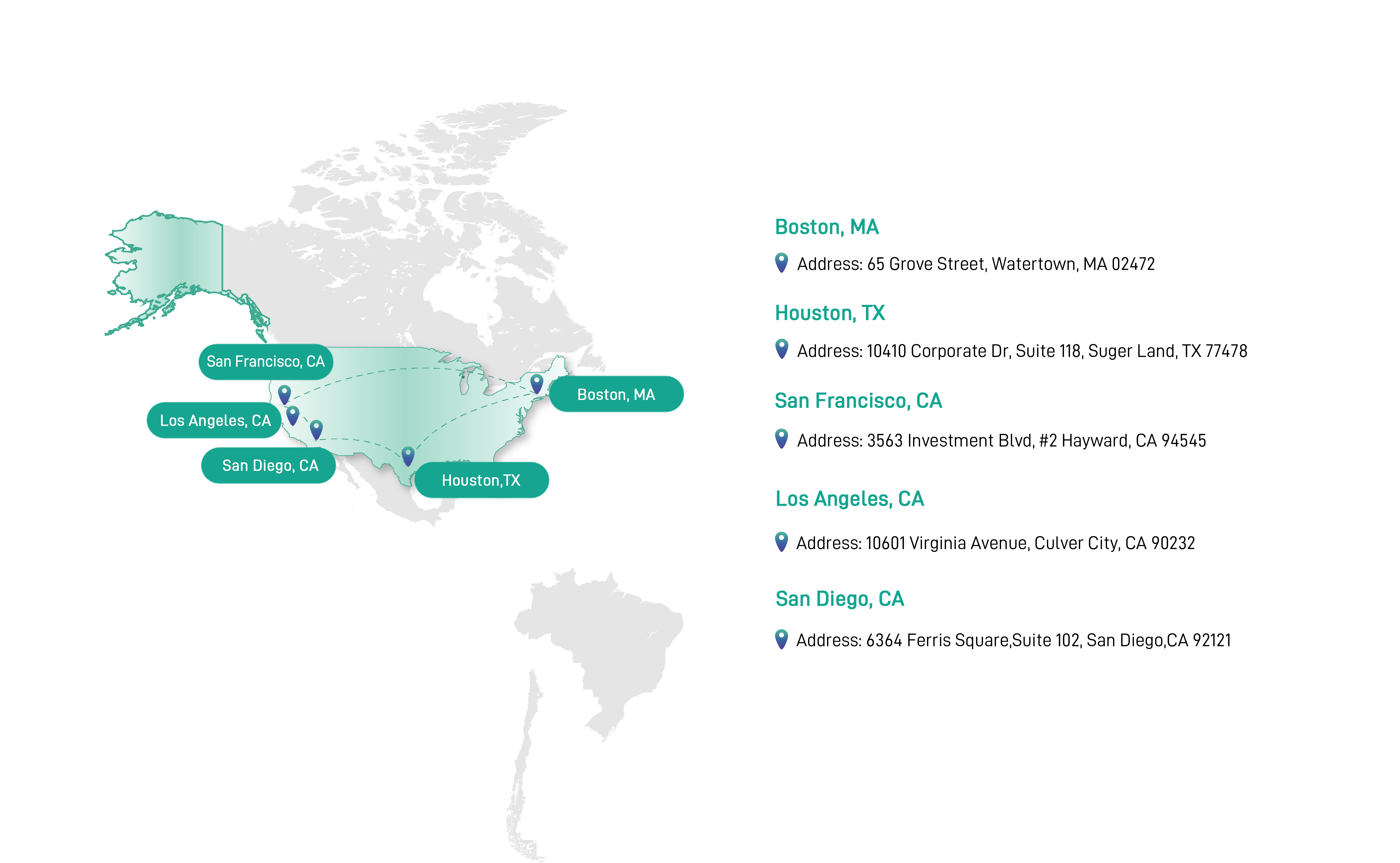
 3563 Investment Blvd, #2, Hayward, CA 94545sales.us@quintarabio.com1-617-789-611165 Grove St, Suite 102, Watertown, MA 02472sales.us@quintarabio.com1-617-789-611110410 Corporate Dr. Suite 118, Sugar Land, TX 77478
sales.us@quintarabio.com
1-424-549-091110601 Virginia Avenue, Culver City, CA 90232sales.us@quintarabio.com1-619-823-08956364 Ferris Square, Suite 102, San Diego, CA 92121Quintara Biosciences © 2025 All Rights Reserved | Site Map | Terms of Use | Privacy Policy


 Login
Login  Order
Order Contact Us
 Contact Us