We Go Fast,You Go Forward
June 08, 2026
Next-generation sequencing (NGS) has revolutionized biological research and clinical diagnostics over the past two decades. Today, two dominant technologies define the field: Illumina's short-read sequencing and Oxford Nanopore long-read sequencing. Understanding their fundamental differences helps researchers select the optimal platform for their specific needs.
At Quintara Biosciences, we provide both Illumina and Nanopore sequencing services, paired with expert bioinformatics support, so you can access the strengths of each technology without investing in expensive instruments. This guide delivers a clear, evidence-based comparison to support informed decision-making.
NGS encompasses high-throughput DNA and RNA sequencing methods that dramatically outperform traditional Sanger sequencing in speed, cost-efficiency, and scalability. Since its emergence in the mid-2000s, NGS has fueled a genomics revolution, enabling the sequencing of entire human genomes in days rather than years, powering large-scale population studies, precision medicine, cancer genomics, and synthetic biology.
Two major approaches currently dominate the field:
Illumina sequencing — The gold standard for short-read, high-accuracy sequencing.
Nanopore sequencing (Oxford Nanopore Technologies) — A third-generation, long-read technology that sequences single molecules in real time.
While both fall under the broad NGS umbrella, they differ significantly in chemistry, read length, workflow, and ideal applications. Choosing between them—or ccombination—depends on your project bojectives, budget, and data quality requirements.
Illumina sequencing, also known as sequencing by synthesis (SBS), is the most widely adopted NGS platform worldwide. It works by fragmenting DNA into short pieces, amplifying them into dense clusters on a flow cell surface, and then adding fluorescently labeled reversible terminator nucleotides one base at a time. A high-resolution camera captures the fluorescent signal after each incorporation, and the terminator is cleaved to allow the next cycle.
This process produces highly accurate short reads, typically ranging from 50-500bp. Illumina platforms such as NovaSeq, NextSeq, and MiSeq excel at generating massive volumes of data with exceptional per-base accuracy, rroutinely achieving Q30 o (>99.9%) or higher. Backed by nearly two decades of maturation, Illumina offers extensive reagent kits, analysis pipelines, and a larger global user community.
Illumina remains the platform of choice for applications that demand high precision and statistical power, including variant calling in large cohorts, RNA-seq quantification, and clinical diagnostics where every base must be called with maximum confidence.
Nanopore sequencing takes a completely different approach. Instead of synthesizing new strands and reading fluorescent signals, it threads native DNA or RNA molecules through tiny protein nanopores embedded in an electro-resistant membrane. As each base passes through the pore, it disrupts the ionic current flowing across the membrane in a unique, measurable way. These electrical signals are captured in real time and decoded into sequence data using advanced AI-powered basecalling algorithms.
Sequencing native molecules without amplification enables long to ultra‑long reads: typically 10–30 kb, with individual reads exceeding 1 Mb and records reaching several million bases. Devices range from the pocket-sized MinION to high-throughput PromethION systems, supporting exceptional portability and scalability.
Key strengths include real-time data output, the ability to sequence native molecules without PCR (preserving epigenetic modifications), and superior performance in resolving repetitive or complex genomic regions.
The most striking differences between the two platforms stem from their underlying detection methods.
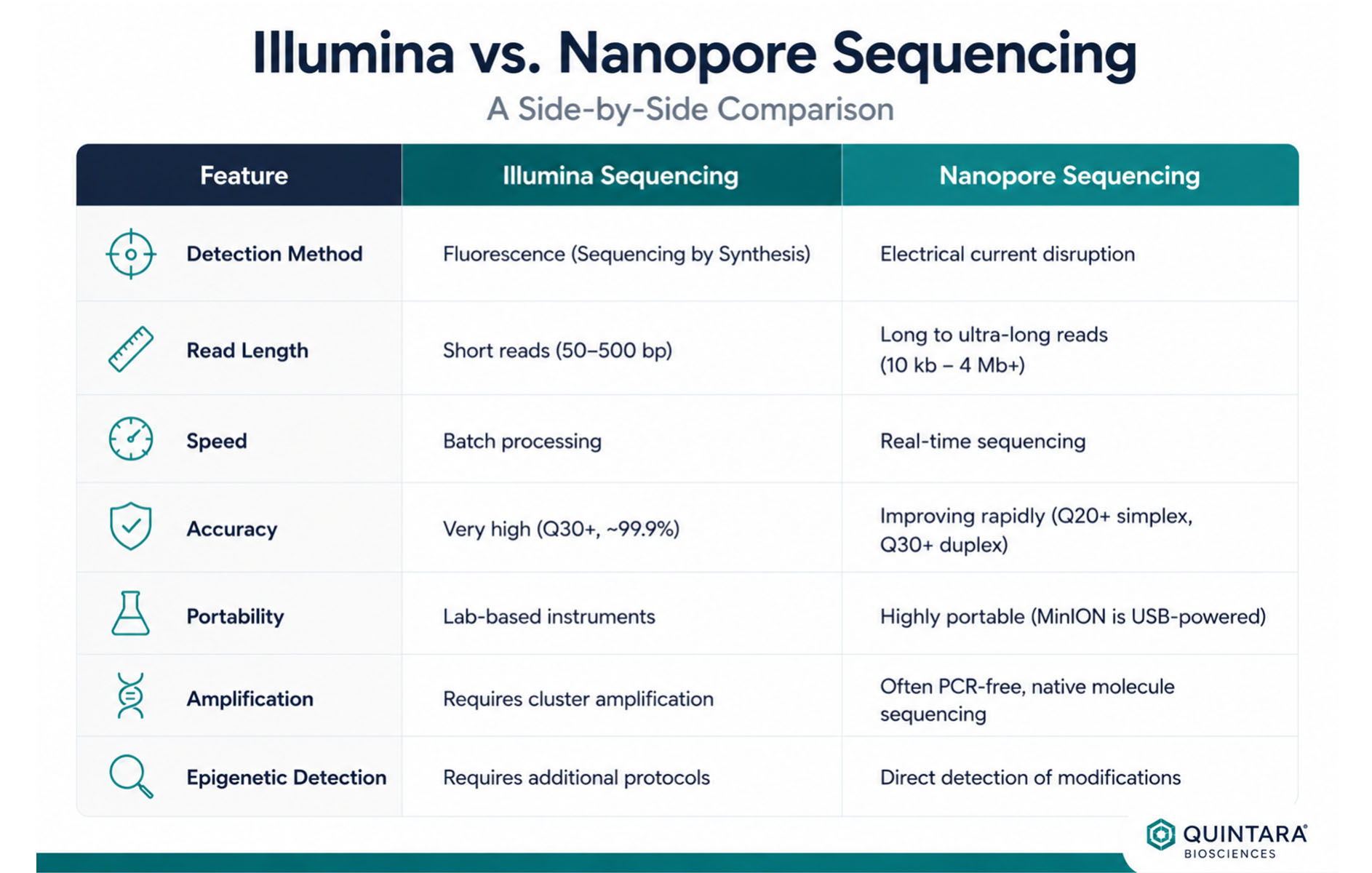
These core differences drive very different performance profiles and use cases.
Read length represents the most dramatic divergence between the two platforms. Illumina's short reads excel at generating dense, high-accuracy coverage but struggle with repetitive regions, large structural variants, and complex genomes. De novo assembly from short reads often results in fragmented contigs because the reads cannot span repeats longer than the read length itself.
In contrast, Nanopore's long and ultra-long reads bridge repetitive sequences and provide long-range connectivity. This makes nanopore sequencing particularly powerful for de novo genome assembly, haplotype phasing, and detection of structural variations such as large insertions, deletions, inversions, and translocations. In many cases, a single nanopore run can produce chromosome-arm-length contigs that would require significant additional scaffolding with short-read data.
For projects involving novel organisms, plant genomes, or highly repetitive regions, nanopore's long-read advantage often translates into faster and more complete assemblies.
Illumina sequencing currently offers the highest per-base accuracy in the industry, routinely achieving Q30 or better across most applications. Its errors are generally random and low-frequency, making it ideal for precise variant detection.
Historically, Nanopore exhibited higher error rates, especially in homopolymer regions and specific sequence motifs, where insertion–deletion (indel) errors were common. However, accuracy has improved drastically with modern advancements:
Latest R10.4.1 nanopore chemistry
AI-driven Dorado basecalling
Single-molecule (simplex) accuracy now exceeds 99% (Q20+), and duplex sequencing reaches Q30+ (>99.9%), matching Illumina levels for many applications.
Many leading labs now use hybrid workflows: combining Illumina's accuracy with nanopore's contiguity for optimal results.
Illumina workflows are inherently batch-oriented. Samples are prepared, clustered, and sequenced together over hours to days, with data analysis typically performed after the run completes.
Nanopore sequencing, on the other hand, delivers real-time data. Basecalling occurs as molecules translocate pores, allowing live run monitoring and early termination once sufficient coverage is achieved. This is transformative for clinical diagnostics, infectious disease surveillance, and field research, where rapid results directly inform decision-making.In time-critical scenarios — such as identifying a novel pathogen or confirming plasmid constructs — nanopore reduces turnaround from days to hours.
When choosing a sequencing technology, cost is rarely just about “price per base.” It depends on your project size, turnaround time needs, read length requirements, and whether you want to invest in your own equipment.
Illumina Sequencing usually offers the lowest cost per base when you run extremely large volumes of samples (hundreds to thousands). It is often the most economical option for deep short-read sequencing, large population studies, or high-volume gene expression analysis. However, starting with Illumina typically requires a major capital investment in instruments, ongoing reagent costs, dedicated lab space, and experienced staff. For many labs and biotech companies running occasional or medium-sized projects, these fixed costs make Illumina less practical.
Nanopore Sequencing has a much lower barrier to entry and offers greater flexibility for most research. You pay primarily for flow cells and library preparation as you use them, with no need for expensive instruments. It is particularly cost-effective when you need long reads for plasmid verification, amplicon sequencing, structural variant analysis, de novo assembly, or rapid turnaround projects.
From a user’s perspective, here’s what it usually means:
If your project requires massive short-read depth on hundreds or thousands of samples, Illumina may have a lower overall cost per base for very large-scale sequencing projects.
If you need long reads, fast results (same-day or next-day), or run fewer to medium numbers of samples, Nanopore sequencing often delivers better total value and faster project completion.
The good news is that you don’t need to buy and maintain your own sequencer to access high-quality Nanopore data.
Quintara Biosciences specializes in professional Nanopore sequencing services. We remove the hardware barrier entirely — you simply submit your samples, and we deliver high-quality long-read results using the latest Oxford Nanopore technology. Our services are optimized for speed and affordability:
Whole Plasmid Sequencing (WPS Express / Standard / Pro) — Ideal for routine construct verification and complex plasmid mixtures.
Amplicon Sequencing (AmpValue / AmpStandard / AmpPro) — Perfect for high-throughput or deep verification projects.
With our streamlined workflow, most projects receive data the next day, and in select regions (including Cambridge/Boston), same-day service is available. This service model can provide a cost-effective and convenient alternative for plasmid, amplicon, and targeted long-read sequencing projects, particularly for organizations that do not require continuous in-house sequencing capacity.
Illumina excels in:
Large-scale population genomics and GWAS
High-precision variant calling and clinical diagnostics
RNA-seq for gene expression quantification
Deep exome or targeted sequencing
Nanopore excels at:
De novo genome assembly and structural variant detection
Metagenomics and microbiome analysis
Full-length transcript sequencing (capturing complete isoforms)
Plasmid and amplicon verification
Field-based or rapid-response sequencing
Direct epigenetic profiling methylation)
Many advanced projects now combine both technologies in hybrid workflows for optimal results.
Yes — and this hybrid strategy is becoming standard best practice in modern genomics.
Illumina provides the high-accuracy base calls needed for confident variant detection, while nanopore supplies the long-range information required for accurate assembly and phasing. By integrating data from both platforms, researchers achieve more complete, contiguous genomes with fewer gaps and higher confidence in complex regions.
Quintara Biosciences supports hybrid sequencing projects by offering both Illumina and Nanopore services under one roof, along with integrated bioinformatics analysis to merge the datasets effectively.
There is no universal "better" technology — only the right tool for the job. Consider these key decision factors:
Project goal: Do you need maximum accuracy (Illumina) or long-range connectivity and speed (Nanopore)?
Read length requirement: Short, high-accuracy reads vs. ultra-long reads for assembly?
Turnaround time: Batch processing vs. real-time results?
Budget and infrastructure: Do you have access to high-end instruments, or do you prefer a service model?
Sample type: Complex genomes, plasmids, amplicons, or clinical specimens?
For routine plasmid verification, amplicon sequencing, or projects requiring rapid long-read data, nanopore sequencing via Quintara Biosciences often provides the fastest and most practical solution.
We help researchers and biotech teams navigate technology choices without the burden of instrument and consumable management. We offer:
Comprehensive Nanopore Sequencing Services, including Whole Plasmid Sequencing (WPS Express, Standard, Pro) and Amplicon Sequencing (AmpValue, AmpStandard, AmpPro)
Rapid turnaround — same-day service in the Cambridge/Boston area and next-day results for most projects
Current promotions: 5 free AmpValue samples and amplicon clean-up at only $1 per sample
Illumina sequencing services for high-accuracy applications
Expert bioinformatics analysis and custom project consultation
Our goal is simple: help you select and access the most appropriate technology for your specific research or diagnostic needs, delivered with speed, reliability, and competitive pricing.
Nanopore and Illumina sequencing each bring unique strengths to the genomics toolkit. Illumina remains unmatched for high-throughput, high-accuracy applications, while nanopore sequencing excels in long-read contiguity, real-time analysis, and portability. In many cases, the optimal solution involves using both technologies together.
Success depends on matching the platform to your research question rather than forcing one platform to fit every need. At Quintara Biosciences, our experienced team guides you through this process and delivers tailored, high-quality sequencing data.
Ready to advance your project? Explore our Nanopore services or contact us for a custom consultation. We help you choose the right approach and execute it efficiently.

We Go Fast, You Go Forward
 sales.us@quintarabio.com
 1-617-789-6111
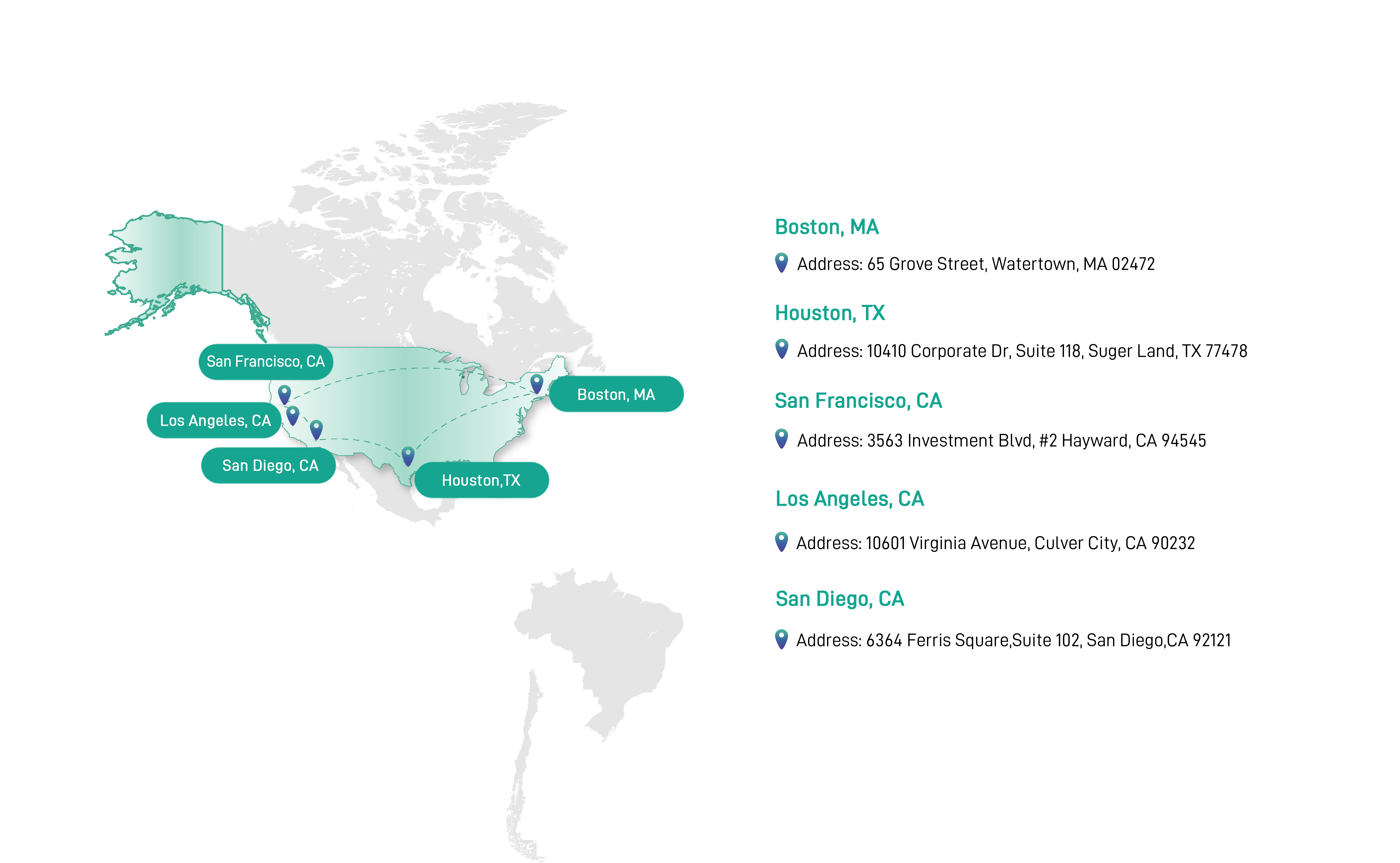
 3563 Investment Blvd, #2, Hayward, CA 94545sales.us@quintarabio.com1-617-789-611165 Grove St, Suite 102, Watertown, MA 02472sales.us@quintarabio.com1-617-789-611110410 Corporate Dr. Suite 118, Sugar Land, TX 77478
sales.us@quintarabio.com
1-424-549-091110601 Virginia Avenue, Culver City, CA 90232sales.us@quintarabio.com1-619-823-08956364 Ferris Square, Suite 102, San Diego, CA 92121Quintara Biosciences © 2025 All Rights Reserved | Site Map | Terms of Use | Privacy Policy


 Login
Login  Order
Order Contact Us
 Contact Us