We Go Fast,You Go Forward
June 24, 2026
Messenger RNA (mRNA) holds great potential for vaccines, protein replacement therapy, cancer immunotherapy, in vivo cell therapy and gene editing. However, naked mRNA faces critical barriers for in vivo administration: it is rapidly degraded by ubiquitous ribonucleases in bodily fluids, triggers strong innate immune responses, and cannot spontaneously cross negatively charged cell membranes.
Lipid Nanoparticles (LNPs) have emerged as the most clinically validated delivery platform to solve these issues. LNP encapsulation physically protects mRNA from enzymatic degradation, shields nucleic acids from immune recognition, and facilitates cellular uptake and endosomal release. For all mRNA-based in vivo research and translational development, reliable LNP formulation and encapsulation are indispensable prerequisites to achieve desired therapeutic efficacy.

Quintara Bio Integrated products & solutions for in-vivo CAR
Four primary biological functions define why LNPs are the gold-standard delivery system:
Physical protection: The lipid bilayer structure encapsulates mRNA inside nanoparticles, preventing cleavage by extracellular RNases during circulation.
Immune shielding: The lipid shell reduces direct contact between mRNA and pattern recognition receptors, mitigating unwanted systemic inflammatory responses.
Cellular internalization: Ionizable lipids and optimized surface properties enable LNPs to bind to cell membranes and enter cells via endocytosis.
Endosomal escape: pH-responsive ionizable lipids destabilize endosomal membranes after cellular uptake, releasing intact mRNA into the cytoplasm for protein translation.
Without proper LNP encapsulation, even high-purity, full-length mRNA will fail to exert biological activity in living organisms.
A typical functional LNP consists of four essential lipid components, each with a distinct role:
Ionizable cationic lipid: The core functional component. It carries positive charge at acidic pH to bind negatively charged mRNA, and becomes nearly neutral at physiological pH to reduce systemic toxicity. It also drives endosomal escape.
Phospholipid: Supports the bilayer structure of nanoparticles and maintains morphological integrity.
Cholesterol: Enhances bilayer stability, reduces particle aggregation and prolongs circulation time in vivo.
PEGylated lipid (PEG-lipid): Improves colloidal stability during manufacturing and storage, and reduces non-specific protein adsorption in biological fluids.
For targeted delivery applications, Quintara Bio offers antibody conjugation (Ab-tLNP), which can be further introduced to endow LNPs with tissue or cell-specific targeting capability.
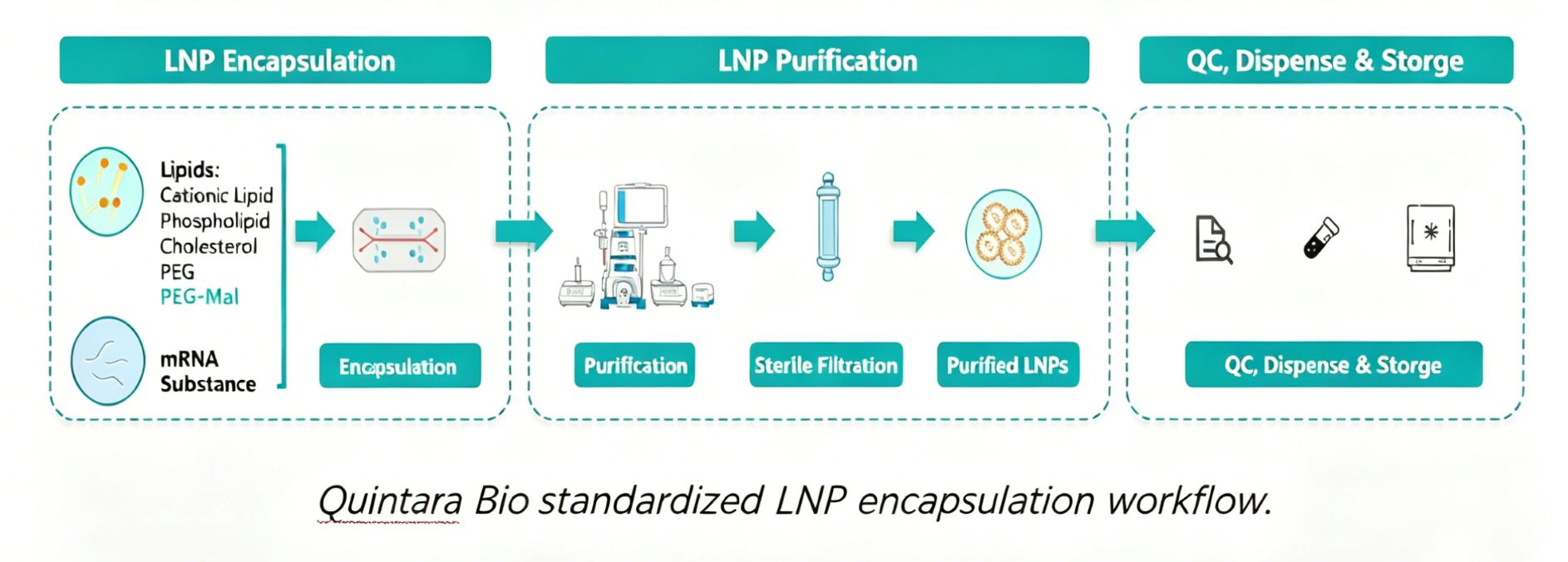
At Quintara Bio, mRNA-LNP production is carried out on controlled microfluidic mixing, the mainstream technology for both lab-scale and preclinical-scale preparation. The process follows a fixed, scalable sequence:
Solution preparation
Lipid mixtures are fully dissolved in ethanol; purified IVT mRNA is diluted in acidic aqueous buffer. The low-pH environment activates ionizable lipids to form electrostatic interactions with mRNA.
Rapid microfluidic mixing
The organic lipid phase and aqueous mRNA phase are injected into a microfluidic chip at controlled flow rates. Fast turbulent mixing drives self-assembly of lipids and simultaneous encapsulation of mRNA, forming uniform nanoparticles.
Buffer exchange & purification
Residual ethanol is removed via dialysis or tangential flow filtration (TFF). The buffer is exchanged to a physiological formulation buffer to stabilize final LNPs. This step also removes unencapsulated free mRNA and excess lipids.
Sterile filtration & finishing
Final LNPs are filtered through sterile membranes, sampled for routine quality checks, and stored under controlled conditions.
This modular process is fully scalable from milliliter-scale formulation screening to liter-scale preclinical batches and further, while retaining consistent particle properties and encapsulation performance.
LNP development and production face multiple interconnected technical hurdles, which directly affect product quality, stability and in vivo performance.
Low Encapsulation Efficiency (EE)
Insufficient electrostatic binding or unstable assembly leads to large amounts of free unencapsulated mRNA. Free mRNA increases immune stimulation and lowers the effective drug dose. This issue often occurs with improper lipid ratios, inaccurate pH or suboptimal mixing parameters.
Poor Particle Uniformity
Heterogeneous particle size and high polydispersity (PDI) cause inconsistent cellular uptake. Oversized particles are easily cleared by the reticuloendothelial system, while overly small particles suffer from rapid in vivo leakage. Batch-to-batch variation becomes prominent during scale-up.
Particle Aggregation & Colloidal Instability
LNPs may aggregate during buffer exchange, storage or dilution. Aggregation is mainly triggered by inappropriate pH, salt concentration or incomplete removal of organic solvent, resulting in formulation failure.
Loss of mRNA Integrity During Encapsulation
Shear force during mixing, unfavorable pH conditions or residual RNase activity can degrade loaded mRNA. Fragmented transcripts lose translation activity, undermining overall efficacy.
Performance Drift After Scale-Up
Process parameters optimized at small scale often cannot be directly transferred to large-volume production. Changes in flow rate, mixing ratio and reaction volume cause declines in EE, increased PDI and inconsistent batch quality.
Limitations of Conventional LNPs (Non-targeted Delivery)
Standard LNPs primarily accumulate in the liver after systemic administration. For cancer therapy, in vivo CAR and neurological applications, the lack of tissue specificity leads to low local concentration and off-target effects.
Based on the above challenges, at Quintara Bio platform, we performed systematic process optimization and formulation design to achieve robust, high-performance mRNA-LNPs:
Optimize Formulation Compositions & Ratios
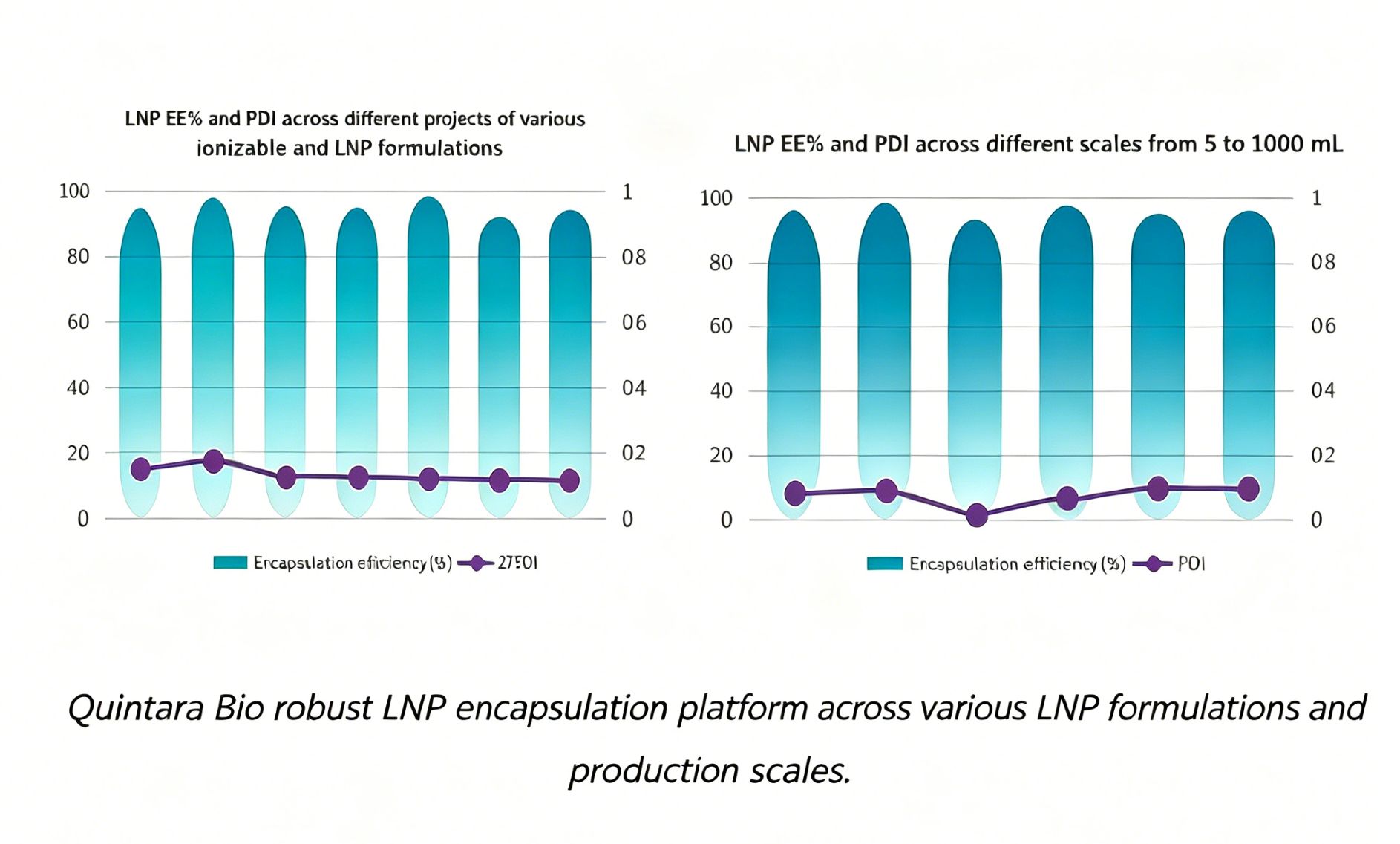
Screen a panel of ionizable lipids and fine-tune the molar ratio of four lipid components. Our platform has rich experience with over 25 novel ionizable lipids, enabling matched formulations for different application scenarios. Rational lipid pairing significantly raises encapsulation efficiency, with average EE maintained above 90%.
Precise Control of Process Parameters
Strictly regulate buffer pH, organic solvent ratio, flow rate and flow ratio during microfluidic mixing. Stable reaction conditions ensure homogeneous self-assembly, keeping average PDI as low as 0.1 across all batches.
Integrated RNase Control System
All buffers, consumables and production environments are maintained RNase-free. The entire workflow is optimized to reduce mechanical shear force, protecting full-length mRNA inside LNPs throughout encapsulation and purification.
Scalable & Transferable Process Design
Develop scale-up-friendly microfluidic protocols. Processes validated at R&D scale can be seamlessly amplified to liter-scale batches, with particle size, PDI and encapsulation efficiency remaining highly consistent. The technology has been verified in more than 20 IND-enabling mRNA-LNP projects.
Stabilization Technology for Long-Term Storage
Optimize buffer formula and apply controlled storage conditions. Formulations can reach a high mRNA concentration of 3.8 mg/mL while retaining long-term colloidal stability on Quintara Bio’s platform.
Targeted LNP (Ab-tLNP) Platform for Specific Delivery
To break liver tropism limitations, we establish a mature antibody conjugation platform. IgG, VHH, scFv and bispecific antibodies can be conjugated onto LNP surface with ~90% conjugation efficiency. The modified targeted LNPs retain stable particle size, PDI and encapsulation performance, enabling precise delivery to target cells or tissues.
LNP encapsulation is the core link that translates in vitro transcribed mRNA into functional in vivo therapeutics. Its fundamental value lies in protecting mRNA, overcoming biological delivery barriers and enabling effective protein expression in living systems.
The main pain points across the whole lifecycle include low encapsulation efficiency, poor particle uniformity, instability, mRNA degradation and scale-up inconsistency. Through rational lipid design, precise process control, strict raw material management and targeted modification technology, these challenges can be well resolved.
A mature, stable LNP platform lays a solid foundation for mRNA vaccine development, tumor therapy, in vivo CAR-T and gene editing research, and accelerates the whole progress from early formulation screening to preclinical and clinical translation.

We Go Fast, You Go Forward
 sales.us@quintarabio.com
 1-617-789-6111
 3563 Investment Blvd, #2, Hayward, CA 94545sales.us@quintarabio.com1-617-789-611165 Grove St, Suite 102, Watertown, MA 02472sales.us@quintarabio.com1-617-789-611110410 Corporate Dr. Suite 118, Sugar Land, TX 77478
sales.us@quintarabio.com
1-424-549-091110601 Virginia Avenue, Culver City, CA 90232sales.us@quintarabio.com1-619-823-08956364 Ferris Square, Suite 102, San Diego, CA 92121Quintara Biosciences © 2025 All Rights Reserved | Site Map | Terms of Use | Privacy Policy


 Login
Login  Order
Order Contact Us
 Contact Us