We Go Fast,You Go Forward
June 30, 2026
Sanger sequencing, often referred to as the chain-termination method, remains one of the most trusted and widely used DNA sequencing technologies in modern molecular biology. Developed by Frederick Sanger in 1977, it delivers exceptional accuracy and clear, interpretable results that have made it the gold standard for targeted sequence validation. Even as next-generation sequencing (NGS) and long-read technologies like Nanopore gain popularity, Sanger sequencing continues to play a critical role in plasmid verification, mutation confirmation, clone screening, and clinical diagnostics — applications where precision and reliability cannot be compromised.
At Quintara Biosciences, we provide high-quality Sanger sequencing services with overnight turnaround, competitive pricing starting at just $4 per sample, and expert support for even the most challenging templates.
Sanger sequencing is a first-generation DNA sequencing technology that determines the precise order of nucleotides in a DNA fragment. It is based on the selective incorporation of chain-terminating dideoxynucleotides (ddNTPs) during enzymatic DNA synthesis, producing a set of fragments that are separated by size and read to reveal the sequence.
At its core, Sanger sequencing offers up to 99.99% base-calling accuracy and read lengths of 500–1,000 bp per reaction. This makes it particularly valuable for any project requiring definitive confirmation of a specific DNA region rather than broad discovery. Unlike high-throughput methods that generate massive datasets requiring complex bioinformatics, Sanger sequencing produces straightforward, visually interpretable chromatograms that allow researchers to quickly assess sequence quality and confidence.
The Sanger sequencing workflow is elegant, reproducible, and highly optimized for targeted applications.
The process begins with high-quality DNA template preparation. Whether using purified plasmid DNA, PCR products, bacterial colonies, or other sources, the quality and quantity of the input material significantly influence the final read length and signal strength.
Next, a single sequencing primer anneals to the template DNA adjacent to the region of interest. In the cycle sequencing reaction, DNA polymerase extends the primer in the presence of normal dNTPs and a small proportion of fluorescently labeled ddNTPs. Random incorporation of ddNTPs terminates strand synthesis at different positions, generating a mixture of DNA fragments of varying lengths, each ending with a specific base.
These fragments are then separated by capillary electrophoresis, where smaller fragments migrate faster through a polymer-filled capillary. A laser excites the fluorescent labels as the fragments pass a detection window, and software translates the resulting signal peaks into a base-called sequence, producing the familiar colored chromatogram.
This workflow allows researchers to obtain clear, high-confidence sequence data from specific regions with minimal ambiguity.
Sanger sequencing excels in any scenario where high-accuracy, targeted sequence information is essential. Skipping Sanger plasmid verification often leads to failed protein expression, wasted cell culture work, and delayed animal trials costing thousands in research resources.
It is the gold standard for confirming the complete sequence of cloned plasmids, including insert identity, orientation, backbone integrity, promoters, and selection markers. Researchers rely on it to ensure constructs are correct before proceeding to transfection, protein expression, or animal studies.
After PCR amplification, Sanger sequencing verifies that the amplicon matches the expected sequence, detects polymerase errors, and confirms successful cloning or mutagenesis.
Sanger sequencing is routinely used to confirm the introduction of specific mutations, SNPs, or small indels, providing definitive proof of successful editing.
Including 16S rRNA sequencing for bacterial strain typing and colony verification in microbiology and environmental studies.
It supports validation of clinically relevant variants, carrier screening, and regulatory-grade sequence confirmation in precision medicine and diagnostic development.
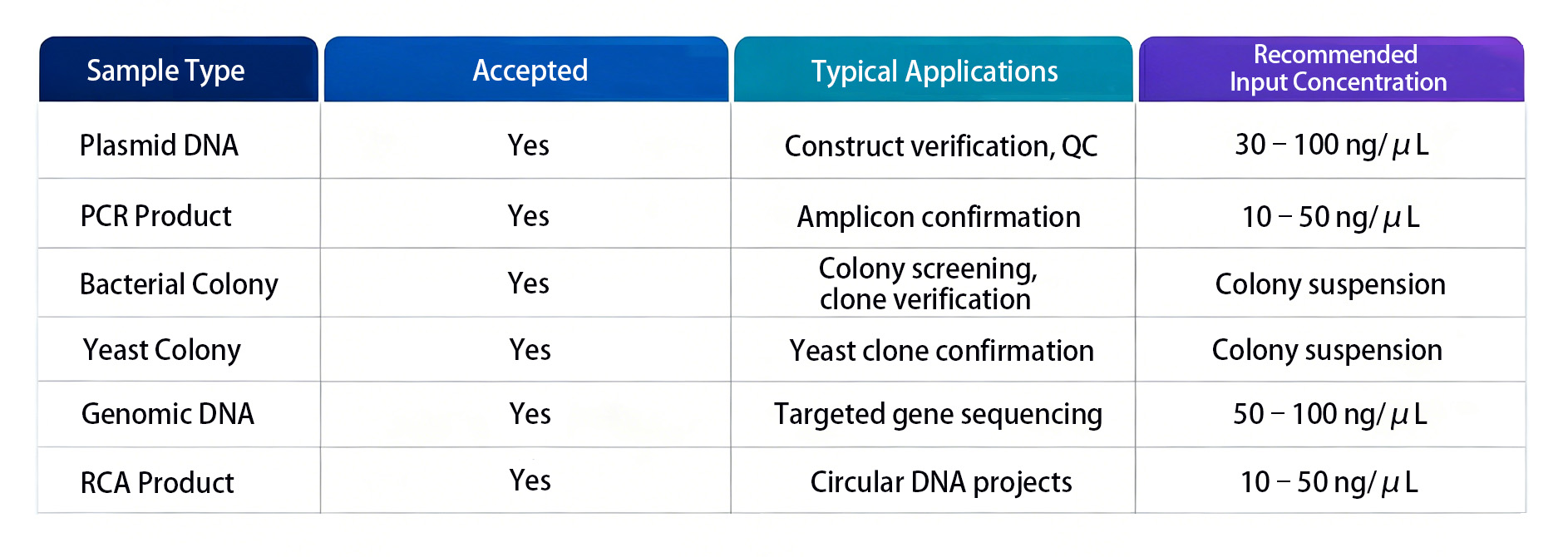
Quintara Biosciences accepts a wide range of sample types for Sanger sequencing, making submission convenient and flexible.
Sample Submission Requirements
Volume: 10–15 μL per sample
Primers: 5 μM recommended (Quintara provides 90+ free universal primers)
Submission: Easy online ordering via QuinGo portal with 1,000+ drop boxes across the US and free same-day pickup in many regions.
A complete Sanger sequencing report from Quintara Biosciences typically includes the AB1 chromatogram file, sequence text file (.seq), base quality scores, alignment results (when requested), and a detailed summary report.
High-quality traces display sharp, evenly spaced peaks with consistent height and minimal background noise. Each color represents one base (A = green, T = red, C = blue, G = black). Overlapping or double peaks often indicate mixed templates or heterozygous sites. Signal drop-off or noisy backgrounds usually result from poor template quality, secondary structures, or contamination. Our team provides expert interpretation support to help researchers understand and troubleshoot any issues.
Several powerful tools are available for viewing and analyzing Sanger data:
Chromas — A free, lightweight viewer ideal for quick peak inspection and basic editing.
SnapGene — Excellent for plasmid mapping, sequence alignment, and visualization of constructs.
Benchling — Cloud-based platform supporting collaborative analysis and annotation.
BioEdit — A classic desktop tool for sequence editing and alignment.
Geneious — Advanced software suite for comprehensive sequence analysis and project management.
Each sequencing technology has its own strengths, and choosing the right one depends on your specific research goals. Here is a clear comparison:
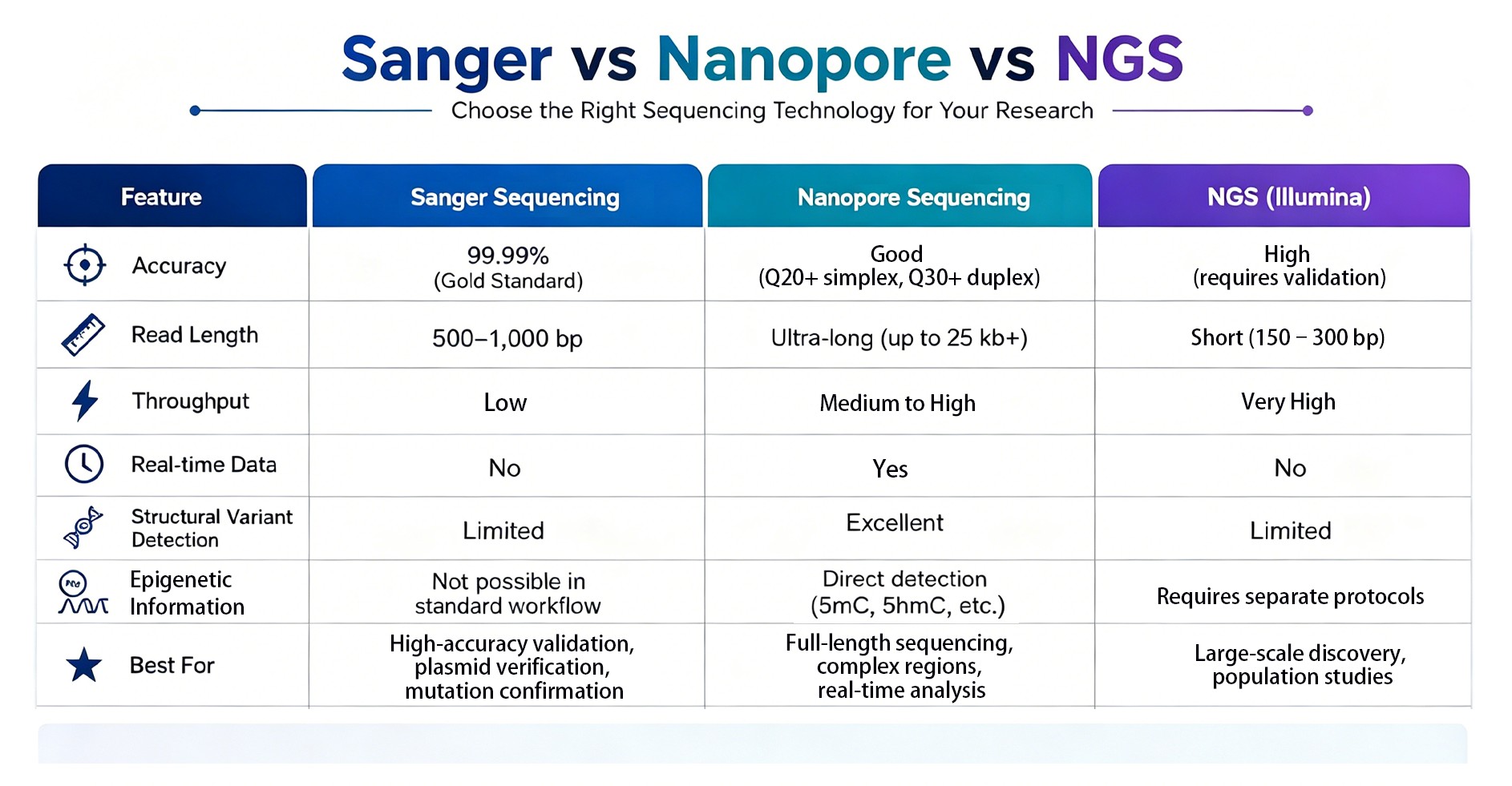
Choose Sanger sequencing when you need the highest per-base accuracy for targeted validation, plasmid QC, or mutation confirmation. Verify candidate variants after screening sequencing by Nanopore or NGS technologies.
Choose Nanopore sequencing when you have a relatively large sample size, or +frequency somatic variants, RNA-seq, and multi-omics high-throughput profiling.
For a deeper understanding of Nanopore technology, we recommend:
What Is Nanopore Sequencing? How It Works, Real Applications, Cost & Illumina Comparison
How Does Nanopore Sequencing Work? Principle, Workflow, and Signal Detection Explained
Sanger sequencing has clear limitations in certain scenarios. Its throughput is much lower compared to NGS and Nanopore technologies, making it impractical for whole-genome projects. Read lengths are typically capped at around 1,000 bp, and it is not well-suited for detecting very low-frequency variants in mixed populations. For large-scale discovery or ultra-high-throughput needs, NGS or Nanopore technologies are more appropriate.
When precision and speed matter, choosing the right Sanger sequencing partner makes all the difference. Quintara Biosciences combines technical excellence with exceptional convenience, making us a preferred choice for researchers and biotech teams.
Key Advantages Include:
For large-scale population screening, full-length long-read analysis or rare variant detection, our integrated NGS and Nanopore sequencing services provide complementary solutions.”
Industry-Leading Overnight Turnaround — Most projects deliver high-quality results overnight, with processing available 7 days a week.
Competitive Pricing with No Hidden Fees — Starting at just $4 per sample, with special Tuesday Promotion: Premixed samples from $3.00 and non-premixed from $4.00 (Promo Code: TueSanger).
90+ Free Universal Primers — Significantly reduces preparation time and cost.
Expertise in Difficult Sequences — We specialize in GC-rich, repetitive, and secondary structure-rich samples that often challenge other providers.
Broad Sample Compatibility — Accepts plasmid DNA, PCR products, bacterial/yeast colonies, genomic DNA, and RCA products.
Convenient Submission — Over 1,000 drop boxes across the US with free same-day pickup in many regions.
Value-Added Services — PCR amplification & clean-up, RCA clean-up, and plasmid mini-preps available to streamline your workflow.
Comprehensive Deliverables — Clear AB1 chromatograms, sequence files, quality reports, and expert interpretation support.
Whether you need routine plasmid verification, mutation confirmation, CRISPR validation, or high-throughput colony screening, Quintara Biosciences delivers reliable, fast, and cost-effective Sanger sequencing with full technical support.
Ready to experience the difference? Submit your samples easily through the QuinGo portal or contact us today for a custom project.
We accept plasmid DNA, PCR products, bacterial and yeast colonies, genomic DNA, and RCA products.
Most projects deliver results overnight or within 24 hours after sample receipt.
It consistently achieves 99.99% accuracy, making it the gold standard for validation.
How do I interpret chromatograms?
Sharp, evenly spaced peaks indicate high-quality data. Double peaks or noise may suggest mixed templates or contamination.
Popular options include Chromas, SnapGene, Benchling, BioEdit, and Geneious.
Choose Sanger for targeted validation, plasmid verification, mutation confirmation, or any project requiring the highest accuracy on specific regions.
Submit your samples through the QuinGo portal or contact Quintara Biosciences today for fast, reliable Sanger sequencing services backed by expert support and industry-leading turnaround.
Sanger sequencing continues to stand as the gold standard for targeted, high-accuracy DNA sequence validation. While next-generation sequencing and long-read technologies like Nanopore offer powerful capabilities for large-scale discovery and complex structural analysis, Sanger remains unmatched when precision, reliability, and clear interpretation are essential — particularly for plasmid verification, mutation confirmation, CRISPR validation, and clone screening.
At Quintara Biosciences, we combine this proven technology with modern convenience: overnight turnaround, competitive pricing, 90+ free universal primers, and expert support for even the most challenging templates. Whether you are working on routine plasmid QC or critical construct validation, our integrated Sanger sequencing services help you move forward with complete confidence in your sequence data. Ready to verify your sequences with gold-standard accuracy? Submit your samples today through the QuinGo portal or contact us for a custom project consultation.

We Go Fast, You Go Forward
 sales.us@quintarabio.com
 1-617-789-6111
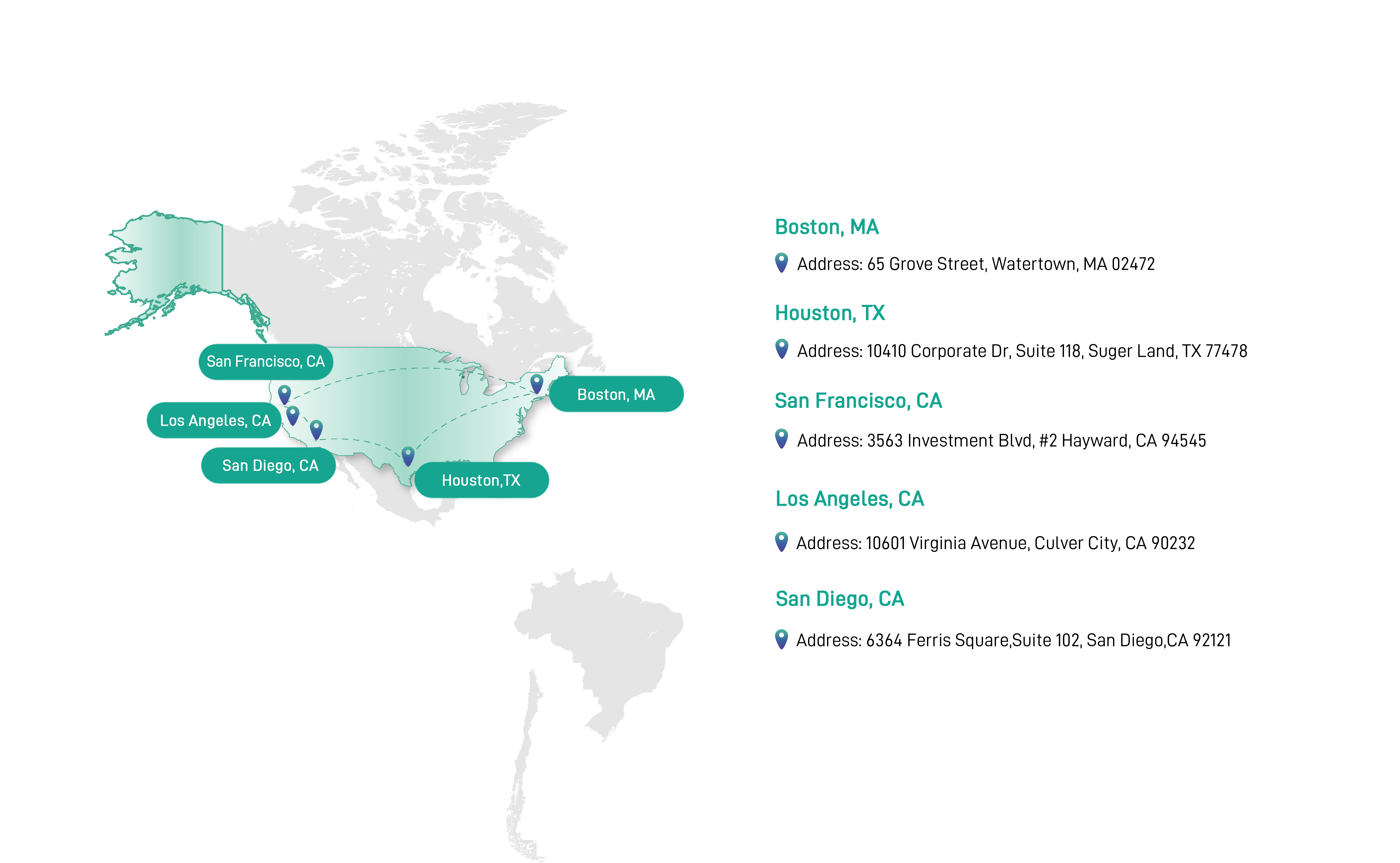
 3563 Investment Blvd, #2, Hayward, CA 94545sales.us@quintarabio.com1-617-789-611165 Grove St, Suite 102, Watertown, MA 02472sales.us@quintarabio.com1-617-789-611110410 Corporate Dr. Suite 118, Sugar Land, TX 77478
sales.us@quintarabio.com
1-424-549-091110601 Virginia Avenue, Culver City, CA 90232sales.us@quintarabio.com1-619-823-08956364 Ferris Square, Suite 102, San Diego, CA 92121Quintara Biosciences © 2025 All Rights Reserved | Site Map | Terms of Use | Privacy Policy


 Login
Login  Order
Order Contact Us
 Contact Us